
Welcome to Jordan, an Arab nation on the east bank of the Jordan River, defined by ancient monuments, nature reserves and seaside resorts. It’s home to the famed archaeological site of Petra, the Nabatean capital dating to around 300 B.C. Set in a narrow valley with tombs, temples and monuments carved into the surrounding pink sandstone cliffs, Petra earns its nickname, the “Rose City.”
Jordan, Is in Southwest Asia, in the rocky desert of the northern Arabian Peninsula. Jordan is a young state that occupies an ancient land, one that bears the traces of many civilizations. Separated from ancient Palestine by the Jordan River, the region played a prominent role in biblical history.
A country located in Southwest Asia bordering Syria to the north, Iraq to the north-east, Israel and the Palestine Territories to the west, and Saudi Arabia to the east and south. It shares the coastlines of the Dead Sea with Israel and the Gulf of Aqaba with Israel, Saudi Arabia and Egypt.
Jordan has had four kings. The Hashemite dynasty is considered by many Muslims to be direct descendants of the Prophet Muhammad. The dynasty’s influence over Jordan came from its role as guardians of the holy cities of Mecca and Medina during the Ottoman era. The current King is Abdullah II, He is a member of the Hashemite dynasty, which has been the royal family of Jordan since 1921.



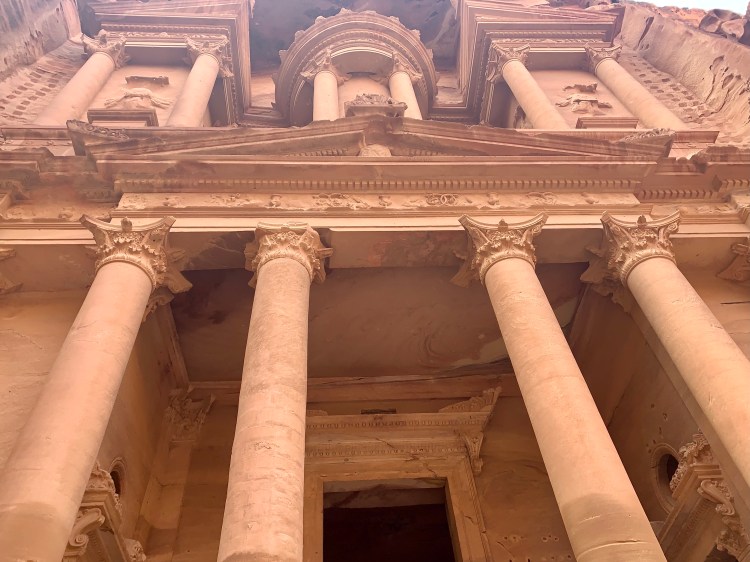
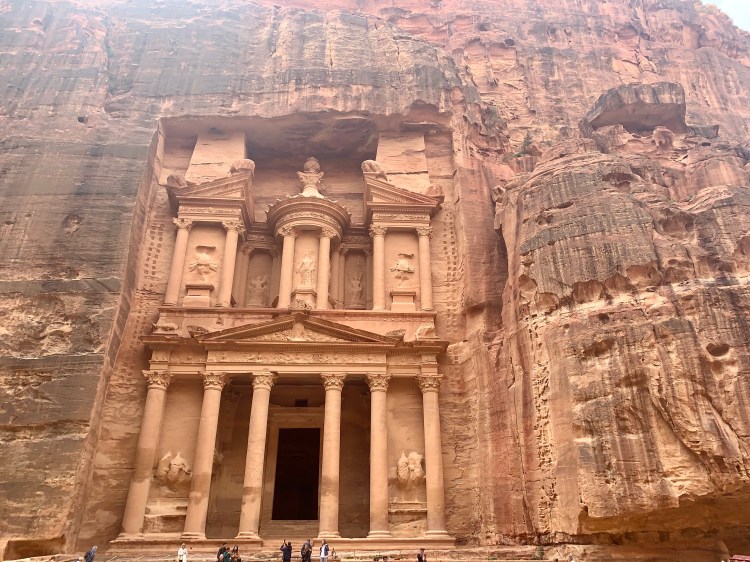
Petra is a famous archaeological site in Jordan’s southwestern desert. Dating to around 300 B.C., it was the capital of the Nabatean Kingdom. Accessed via a narrow canyon called Al Siq, it contains tombs and temples carved into pink sandstone cliffs, earning its nickname, the “Rose City.” Perhaps its most famous structure is 45m-high Al Khazneh, a temple with an ornate, Greek-style facade, and known as The Treasury. Petra is Jordans most visited tourist site and has been named one of the seven wonders of the world and a Unesco World Heritage Site.
 theroamingretirees.net